Wednesday, November 9, 2011

Head of the American 2011 - Part 1

Valuable lessons are often learned the hard way. 
 ----------------------
Beautiful day at Lake Natoma for Head of the American
If you have never been to the Head of the American (HOA) at Lake Natoma near Sacramento, the course is beautiful with only one gradual turn and water that is only mildly disturbed.  The wind is typically a tailwind and only on occasion becomes a headwind or becomes treacherous. 

The regatta itself is usually run with impeccable efficiency, but as with many large regattas, it is can become what Chris calls a “madhouse.”  Being a madhouse is one of the reasons HOA is so great—there are competitors who travel from LA, San Diego, Oregon, or sometimes even farther.  

HOA is THE Northern California head race.  Newport Autum Rowing Festival (NARF) is THE head race for Southern California, drawing crews from the Bay Area, Arizona, and farther.  Between the two, you are to find some tough competition.

Two weekends ago, I learned and re-learned a number of valuable lessons at HOA.

#1.  Always be prepared.  Better to be prepared the night before.
The preparation for a race should begin the night before—packing the clothes, gear, and food that you will need.  The night before HOA, however, my husband and I took the Princess to a wonderful Halloween costume event at the Palo Alto Children’s zoo.  Thankfully, the Princess already had a nice, pink Chinese-styled outfit that we could pass off as a costume.  What was she dressed as?  A Chinese princess, Chinese girl, Chinese doll, Chinese screaming terror.  Whatever works.

The Princess at Halloween,
wearing her Chinese outfit.
From the zoo, we stayed with my parents where Grandma and Grandpa could pander the Princess even more and hopefully give my husband a break from the Chinese screaming terror while I spent all of Saturday at HOA.

Needless to say, I was not very prepared for race day.  I had frantically thrown clothes into a bag before we left for the zoo, but did not have time to properly pack food, water, tools.  I had thought that I might be able to pack food from my parents’ house, but I had forgotten that they actually cook from scratch and did not usually have pre-made food ready to go.  A bundle of raw bok choy was not going to cut it.  I grabbed some apples and bananas and left the house at five in the morning. 

I managed to grab a coffee and some oatmeal from Starbucks.  My mixed doubles (Mx2x) partner also was much better prepared than me and kindly shared some delicious, homemade date and fig bars. 

It is not as if I would have starved.  Regattas typically have food vendors and clubs usually have a pile of community food to share.  From my lightweight days and binges after weigh-ins, however, I learned that I want to eat things that are fresh and make me feel good instead of eating heavy pastries or mouth-watering baked goods.  My team also loved to eat peanut butter, which is a great race day fuel, but not when you eat spoonful after spoonful of it.
Old photo from college, eating peanut butter
I also did not bring enough water.  I had half-anticipated the weather to be mild and cool, but weather was relatively warm for a late fall day in California.  Before my first race, I had already drunk all my water and forgot to get more before our hurried launch.  Luckily, we were able to snag a small water bottle from the BIAC team, but had the day been any warmer, that small bottle would not have been enough.

#2.  Never underestimate how much stress and nerves can unnerve you.
HOA is a huge regatta and amidst all the chaos and distractions, you have to be able to manage your own equipment, time, fueling, check-ins, weigh-ins, anything that could go wrong and still get to the start line on time.  When you have a coach to help you, things are a bit easier and the coach usually has all the bow numbers, safety pins, extra tools, electrical tape, race plan, hands-on and launch times ready.

I had forgotten how lonely, chaotic, and overall, more stressful it can be as a sculler without the supervision of a coach.  My first race was the masters 2x at noon followed by the open 1x three hours later.  The timing should have been enough, even luxurious, but I had squandered much of the morning catching up with old acquaintances, helping out, and scrambling for the little things, as seen from my lack of preparation (Lesson #1).  In addition, my Mx2x partner had a race at 10:30 and did not get off the water until 11:10.

By the time we hurriedly beach-launched (launching directly into the water and not from a dock), it was already 11:30.  Mentally, I was in near panic.  I knew there was a significant penalty to being late to the start and without having been on the course yet, I was unsure of how much time it would take to get there.  Thankfully, my Mx2x partner was of a much calmer mind and we arrived to the start with about five minutes to spare.

There were only two other boats in my 1x race and coincidentally, I knew both rowers personally.  After I had started rowing in college, I spent the subsequent summer in the Los Angeles area, rowing out of a small boat club.  There, I met the two rowers separately, and we all had the same coaches at some point or other.  Then, I had looked at them, as someone who gazes off at the moon, something so far and out of reach.  Although the two were at different points of their rowing careers, both were motivated and strong with a large amount of potential.  And I was not sure where in the picture I fit in. 

I had never raced them before, and HOA was the first chance in the five years since.  I wanted to race well against them, to see how far I had progressed and maybe places where I lacked.  Racing well means having your head in the game, being prepared, and eating up pain like it was good for you.  Although I am much more experienced now than five years ago, the stress, nerves, panic, and distractions before the race were a good reminder that there is still a lot that I have to master as a racer.

#3.  If you race in a men’s race, don't expect to make any friends.
Due to the order of events and timing between them, my Mx2x partner and I raced in a Men’s Masters 2x instead of the usual Mixed Masters 2x.  Now instead of having to pull my weight and age, I had to pull my weight, age, and sex. 

When we arrived at the start, we had about five minutes to spare (see Lesson #2), but our event was already lined up—eight other men's doubles ready to go.  As I steered the boat to cross the buoys into the starting area, the official flagged me down and told us to not cross, but proceed down to where other boats were continuing their warm-up. 

For a moment I was confused about why the official would not allow us to line up with the other men’s doubles.  Then, I remembered that we were probably the ones to confuse him.  The mixed 2x race was not for another hour or so.  

I replied to him that we were in this race, pointing to the other men’s doubles.  He looked down at his sheet and looked up, “You are in this race?  Men’s masters double?”  I responded, “Yes, we are.  Yes, I know.”  We were clear to line up, fourth boat to start. 

By this time and by the small commotion that we created, all the other boats were curious and we turned to find ourselves being stared at.  The stares became incredulous looks as they realized that we were in their race.  To top it off, my Mx2x partner who had done his research on the competition was feeling particular convivial and tried to strike up a conversation with the previous champions of this race, a crew from Ashland who had a massive age handicap on us and who looked none the pleased to race a mixed boat.

Typically in rowing, the two genders do not mix unless it is an explicitly stated mixed race where at least half the boat must consist of women.  On occasion, however, rowers can race “up”, i.e. race in a more competitive category.  For instance, women can race in men’s races and lightweights can race in heavyweight races, but not the reversed.  Just remember that if you are a woman racing in a men’s race, none of the men will be too thrilled.

It felt good to actually start racing so that everyone would stop looking over at our boat.  We started strong and settled into a good rhythm.  The boat ahead of us was struggling and we passed them quickly.  The next 1000 meters were spent catching the San Francisco Bay Blades double, one boat with friendly faces.  Then, if I almost completely turned around, I could see the Ashland boat much farther ahead of us.  I tried to make calls to focus on things that would generate more speed in the boat.  Sometimes the boat responded, and sometimes the set was just slightly off or our strokes not clean enough to gain more ground.  For much of the race, the Ashland boat had significant amount of open water. 

With about 1500 meters to go, I could see that the distance had closed, and I called a twenty, thinking that we would be able to catch them quickly.  I could see their boat moving away from the buoy line, the shortest course, and it seemed like they were yielding that course to us.  I severely overestimated our speed and underestimated their determination.  They hung onto that lead with about two lengths of open water and moved back towards the buoy line.  

In about the last 1000 meters, we took the buoy line and quickly closed on them.  From there, I could see them in the corner of my eye and we were soon bow-to-stern.  We could hear shouting and cheering from the shore, and I think I even heard my name.  We continued to move up, but for every stroke that we willed to propel us ahead, it felt like they dug deeper and fought harder.  We fought for every inch down the stretch and crossed the line just 1.1 seconds after them. 

My initial gut reaction was disappointment.  Disappointed that we needed every stroke of that race to count and that there were strokes in there that we could have done better.  Disappointed that when it came down to the end, we were not able to edge them out.  Disappointed that maybe if I had just given a little more, sat up a little taller we would have had them.

With a more perspective and level-headedness, we raced really well.  We started strong, were consistent, and finished strong.  Just a little more speed and quickness in the last 500 meters might have been enough to cross the line first, but you cannot ask for something that you do not have.  In the end, crossing the line would not have given us a win.  Due to the age handicap, we needed almost two more minutes to win.

Mens Masters 2x Final
  1. Ashland - 17:29.97 (raw - 20:26.17; finish time at 12:20:42.60
  2. BIAC/LMRC - 19:20.65 (raw - 19:28.45; finish time at 12:20:43.73)
  3. MRA - 19:27.87 (raw - 20:59.77)
  4. OARS - 20:24.54 (raw - 21:56.44)
  5. RCRC - 20:58.35 (raw - 23:29.05)
  6. Stan RC - 22:47.28 (raw - 24:00.68)
  7. SFBB - 23:37.10 (raw - 23.37.10)
  8. SRC - 25:50.05 (raw - 26:03.05)
  9. PCDW - 30:01.64 (raw - 20:23.94)

Regatta results can be found here.

Thursday, November 3, 2011

Wine Country Regatta 2011 - Part 2

Goodbye October and welcome November, already!  Wine Country regatta was two weekends ago, and it already seems to be a somewhat faded memory.

Read about the Wine Country regatta Part 1, race report of the double here.

After the double's race, my mixed doubles partner and I paddled to the North Bay Rowing dock to launch the quad.  The race was a mixed masters quad.  Mixed because at least half of the boat must consist of women, and masters because well, there was not an open race choice.  Now, I had to pull my weight and age.

More importantly, this mixed quad was to be stroked by our coach, Chris.  Chris has been around the Bay Area rowing scene for countless years and about two years ago, added the Lake Merritt Women's team to his list of coaching responsibilities, which include Berkeley High, Open Water Rowing, and Summer Youth Rowing.

There is something unnerving about rowing in the same boat as your coach.  Sure, in this case, I was sitting in bow with no one to see my poor technique or missed water except for the spectators and the cameras.  However, bow seat in a quad also steers the boat in a head race, and stroke seat can tell pretty clearly whether or not the steering is straight.

The last time I was in a the same boat as my coach was in the summer of 2009 (the same summer my brother and I rowed at the lake together) at Southwest Regionals, also held that year at Lake Merritt and also, in a quad.  Sitting in two seat, right in front of our coach, Dede, was pretty nerve-wrecking, especially at a time when I was just becoming comfortable sculling.  We ended up winning our race, even with the age handicap, but I never had the nerve to ask Dede how I did.

Left to right (bow to stroke): Dede, me, three seat, stroke or four seat
There is also a little secret about quads that some rowers do not know about and that I did not learn until after rowing with Dede.  If you have the right rowers in the boat, quads can be FAST and QUICK.  So fast and quick that it becomes hard to feel the boat.  You are almost not sure whether or not you are actually pulling.  In smaller or slower boats, including slower quads, you feel some heaviness at the catch and you can feel the water run under the boat as you drive and swing.  In a fast quad, you have to row differently.  Instead of emphasizing the swing, you have to think about just tapping the boat along, quick rowing without disturbing the speed of the boat.  It is a hard concept to think about and even harder to execute properly.  The Wine Country regatta mixed quad reminded me of why I have an almost allergic reaction to the quad, but a natural affinity to the single or double.

Left to right (stroke to bow): Chris, three seat, my Mx2x partner, me

The moment we started rowing in the quad together, there was a feeling of secret, unspoken surprise and elation--the boat felt GOOD.  The boat felt effortless as it glided through the water.  We reached the start line with a few minutes to spare, as we all waited for the last quad, a BIAC and Los Gatos Rowing Club quad to pull up.

As the first boat of four total to start, we quickly built to rate and settled in to a rhythm.  Perhaps, it was our nervousness or overexcitment, the change in direction of water, or my steering, but that secret magical feeling from the warm-up disappeared and we had to settle for "pretty good."  The boat ran smooth enough with a few dips to one side or another, especially when I looked back or steered the boat, using the rudder.

Learning from my course in the doubles race, I knew the straight sections of the course would be the hardest.  With uniform marshlands to look at and no outstanding landmarks as points, it could be hard to keep a straight course without constantly looking back.  On the second or third straightaway, right after a turn to starboard and at a large gap between marker buoys, I tried to stay close to the center of the river to catch the in-bound current, but overshot.  A nearby launch shouted at us and I quickly corrected my mistake, but not before you could see my mistake reflect in trailing wake of the boat.  I know Chris saw too.

As we approached the finish line, we heard cheers from the few scattered spectators and especially from the North Bay Rowing Club president who had been so generous in loaning the boats to us.  After we crossed the line, we sat, watched, and waited for the other boats.  Chris reminded us of the age handicap and even after the other boats finished, we were not sure if we had beaten the other boats.

Regardless of results, that quad was exhilarating to row.  Even on the paddle back, with a low stroke rate, there was huge amounts of run in the boat.  The race was a good reminder for me that there is still a lot to work as bow seat in a quad.

In the end, we did overcome the age handicap to win the race.

Thursday, October 27, 2011

INSOMNIA

It's nearly two o'clock in the morning, and I am sitting here wide awake.  The husband and The Princess all sound asleep, ready to wake up rested and refreshed. 

Insomnia never happens to me.  I am usually the one person at parties who cannot keep her eyes open past 8:30.  Ask anyone who has had to cart me home, not because of drunkness, but because at that point in time, I could just drop and be gone--out like a light.

I am not sure why I am awake like it is nine o'clock in the morning and as if I have already had my cup of coffee.  Maybe it was the coffee that I had this morning.  Or maybe it was work unconsciously running around in my head.  Or perhaps, I am just so nervous for this weekend's Head of the American race.  Or maybe the nagging, mild discomfort in my shoulder and hip was keeping me up.

At about an hour ago, at one in the morning, I had given up trying or pretending to sleep.  One cup of cookies and one generous handful of almonds later...

Tuesday, October 25, 2011

Wine Country Regatta 2011 - Part 1

In the fall, rowing centers around head races, approximately 5,000-6,000 meters or about 16-25 minutes depending on your speed and boat class.  In comparison, the spring and summer races are 1,000-2,000 meters, 4-10 minutes.  Think cross-country running in the fall versus track and field in the spring.

This past weekend was the Head of the Charles regatta in Boston.  Congratulations to all the finishers!  Extra special congratulations to Kristin who won the Lightweight Women's Single, defending her 2009 title!

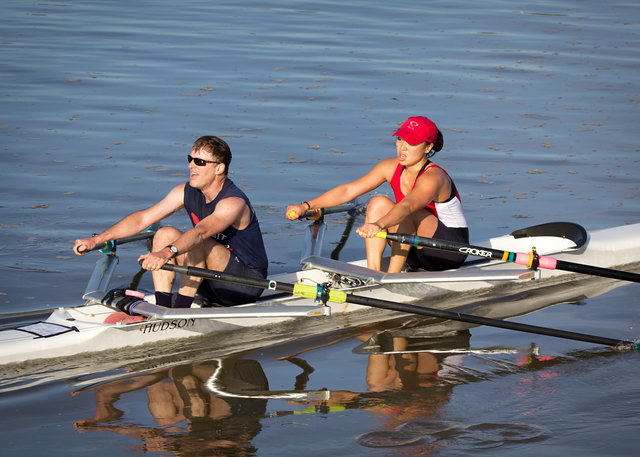
Borrowed North Bay Rowing Club's (NBRC) Hudson 2x
for Wine Country


Racing at home, at the Petaluma Wine Country Classic head race, was in even more beautiful and warm weather than in Boston.  The water was relatively calm and the sun gently beamed down all day.  It was great to see the LMRC team again as well as the Cal Lightweight women racing.  In fact, on the trailer loaded with LMRC boats and Cal Lightweight boats, I saw a familiar boat, the Little Debbie, which I rowed in in college.  Brings back mixed memories.

The Little Debbie 4+ still chugging along!

I had two races for the day--a mixed double and a mixed quad.  For both races, North Bay Rowing Club was generous enough to lend us boats to use.  The double was a Hudson double with toe steering in bow.  It is not unusual for a double to have toe steering since it is a blind boat, but we do not normally row with one, instead relying on ourselves to do all the steering.

After the coaches and coxwains meeting, which reviewed the course and racing rules, my mixed double's (Mx2x) partner and I loaded our oars into his Honda Civic and drove over to launch from the NBRC dock, close by.  We made foot stretcher and spacer adjustments to the boat and then, were out on the water.

The row to the start line took longer than I had imagined, and I began to worry that we would be late the start.  Luckily, the race was delayed by five minutes and we were not the last double to our race.  We were, however, the first boat to start.  The other weird thing about head races is that boats do not start simultaneously, but rather sequentially, similar to a cycling time trial.  The winner is determined by the fastest time and not by who crosses the line first.

"Number 51, Lake Merritt composite. You may row."  In head racing, you actually start rowing about 100-150 meters behind the start line.  You start on the paddle and gradually build speed.  The goal is to reach your optimal speed, rhythm, and rate at the time that you cross the start line.

Masters 2x

We quickly settled into a good rhythm.  The first 1,000 meters of the course was straight until a turn to port followed by another straightaway.  The boat felt good, but on the straightaway, there were not many buoys to guide my course, I could see the wavering in my steering.  If you look ahead to the stern of the boat and if you are steering straight, you should see a straight line.  In my case, I could see where the line slightly curved and where I had corrected or overcorrected my course.

Masters 2x

At about halfway, the boat felt heavier at the catch, which was odd.  Our rowing felt pretty consistent and we were supposed to have a current carrying us.  Then, I realized that there was a small headwind.

The last 2,000 meters of the race were harder than I had expected.  Because of the age handicap and the fact that we started first, I was not sure how well we were doing compared to the other boats.  As we crossed the finish line, I was wondering how we were going to race again in an hour.  We did not wait for the other boats to finish or to count the seconds between us and them.  We rowed back to the NBRC dock to get hands on the quad.

Friday, October 21, 2011

Head of the Charles Weekend

Outside of the Olympics and World Championships, the Head of the Charles (HOTC or HOCR) is THE rowing event in the US.  Even IRA, NCAAs, and Harvard-Yale Boat Race have to take a back seat to the HOTC.  Usually infamous for Bostonian bad weather, word on the ground is that this year's HOTC is actually going to have good, non-rainy, non-snowing weather.  There might even be a chance of sunshine, although note that the temperature is predicted to be a cool 60 degrees.

The schedule is available here, and the two-day regatta can be watched live online here.

Here's a list of boats that I will be cheering on:
  • Event 6 Sat 9:46 -- Women's Senior 50+ Eight -- Syracuse Chargers Rowing Club (LMRC rower stroking)
  • Event 8 Sat 10:08 -- Women's Senior 50+ Four -- Community Rowing (LMRC rower)
  • Event 14 Sat 11:48 -- Women's Club Single -- BIAC
  • Event 16 Sat 12:44 -- Women's Club Four -- BIAC and Union Boat Club
  • Event 19 Sat 13:43 -- Mens Master Double -- BIAC
  • Event 44 Sun 12:40 -- Women's Lightweight Single -- University of Wisconsin Alumni (Go Kristin!!)
  • Director's Challenge Sun 12:59 -- Men's Quad -- (a quad with Cal Lightweight alumnus...  Go Nick!)
  • Event 48 Sun 14:31 -- Women's Championship Four -- LMRC

Closer to home, this Sunday is also the Wine Country 5k regatta in Petaluma, same venue as the Petaluma River Marathon.  Race schedule can be found here.  Be HUNGRY.  Be ready for some racing.

Monday, October 10, 2011

Vegas

Only one closet of several, lined with dresses
and shoes, none of which belong to me
In the Bay Area, this past weekend was the Head of the Port, held in Port of West Sacramento, hosted by River City Rowing Club.  Results are posted here.  It looked like a good day for Lake Merritt and the Cal Lightweight men who raced several heavyweight crews.

Instead of doing anything productive, such as racing at Head of the Port, the weekend was spent in Las Vegas for a good friend's bachelorette party.  Living it up in style at the newly-built Planet Hollywood Westgate Tower suites, there was plenty of sleeping space, alcohol, junk food, and bathroom space for ten girls.  If you have not figured out by now, I am an old lady who is married, has a kid, and just struggling to get by with a clean house.  Partying and Vegas are not really ever in the cards.  So this trip was a trip to see how this whole Vegas thing is really done.

Going out to town required a three to four hour getting-ready, make-up period and the experienced party girls made it look like a controlled massive production line--shower, make-up, dress, hair.  Apparently, for girls, it is key to look the "part" in order to cut lines at clubs and get free admission. To my chagrin, my one-and-a-half inch black heels that I normally wear to work was not going to cut it.  After much peer pressure, we went shoe shopping (luckily, the Miracle Mile shops were right downstairs).

I have this bad habit of acquiring new shoes when I travel.  My husband who owns maybe three pairs of shoes and who wears his shoes until the soles are falling apart, always has this skeptical look of when accosted by the latest shoe acquisition.

Latest and greatest (and absolutely non-function) pair of shoes
Unlike the last pair of shoes I brought home from Colorado, this pair from Aldo were wedges, which, as I was informed, are quite in-style now, and had a heel about three-and-a-half inches.  Trust me, there were many other more extreme choices, but this was the pair in which I would not break an ankle and which I might possibly where on another occasion.

The first night was spent at two clubs.  By the third hour, I felt like Cinderella who had managed to squeeze her foot into the glass slipper, but found out that the more she stands, the larger her feet become.  Every other woman was wearing shoes like mine or even more ridiculously taller and uncomfortable.  If there was a woman there who said that her feet did not hurt, she is LYING.  The absolutely stupid things women do for beauty.

The second night, I ditched the new shoes and wore my plain black, grandma shoes.  Much more comfortable.  Thank goodness.
Picture with the bachelorette and grandma shoes

Sunday, October 2, 2011

Welcome to Bair Island Rowing Club (BIAC)

BIAC boathouse and erg room
The move to the South Bay with a new home and new job would not be complete without a new rowing club.  Despite the vast bay, rowing here is pretty much limited to two areas--Lexington Reservoir in Los Gatos and Redwood City.

I have joined Bair Island Rowing Club, also called BIAC (Bair Island Aquatic Center), the most conveniently located boathouse to my work and commute.  BIAC is located in Redwood City at the city port.  Like most ports, the Port of Redwood City is not located in the best of neighborhoods.  The area is crowded with industrial factories and large tugboats shipping goods in and out of the port.  In addition, there is an extra bonus of a women's prison nearby the boathouse!  Just like in Oakland, it is best not to leave anything of value in your car.  You never know which shady character will take a rock to your car window...

Other notable ports in the Northern California include the Port of Oakland (the estuary) where the Cal Lightweights, Cal Heavyweight men, Berkeley High, Oakland Strokes, and East Bay Rowing Club row and the Port of West Sacramento where UC Davis and River City Rowing Club row.  None of these areas are the nicest or safest of neighborhoods.

BIAC docks and nice, flat water
Luckily, there is an upside to BIAC's shoddy location.  The water is, for the most part, flat and calm for 2,000-3,000m out.  As the estuary widens and pours into the bay, the water becomes rougher and eventually, you end up rowing in the bay where you can see the Dumbarton Bridge on one side and the San Mateo Bridge on the other.  The mornings are very dark with lights blinking far away on the shore; without knowing the course and being able to see in the dark, it is very easy to become disoriented.  A number of green and red channel markers can guide you, but the lights flash so damn infrequently that they are easy to miss.

This body of water can get crowded in the mornings with a variety of teams that include Stanford varsity crews, the Stanford junior rowing program or Peninsula Crew, Palo Alto Rowing Club (juniors), and NorCal crew (juniors).  In fact, BIAC shares its boathouse with the NorCal crew.  In the mornings during the school year, the boathouse teeming with high school boys and girls who cannot seem to stop talking at 5 in the morning.

BIAC boats all stored outdoors; covered singles are private boats
BIAC is a fair number of boats, all stored outside, that are shared between all the teams.  There is also some storage for private boats.
Club singles, mostly Aeros, Maas 24s and 27s, and flyweights

Club singles
BIAC masters have an advanced mixed masters team, an intermediate mixed masters team, and individual scullers.  The club also puts on a number of regattas in the fall.  The fall BIAC regatta with its infamous turns and crabs is actually held in the San Mateo Lagoon.  The other regatta is at the BIAC home course and also consists of a number of turns and twists, hence the name "corkscrew."

Mark your calendars!
BIAC 20th Annual Fall Regatta - Sunday, November 6th, 2011
BIAC 5th Annual Corkscrew - Sunday, December 11th, 2011